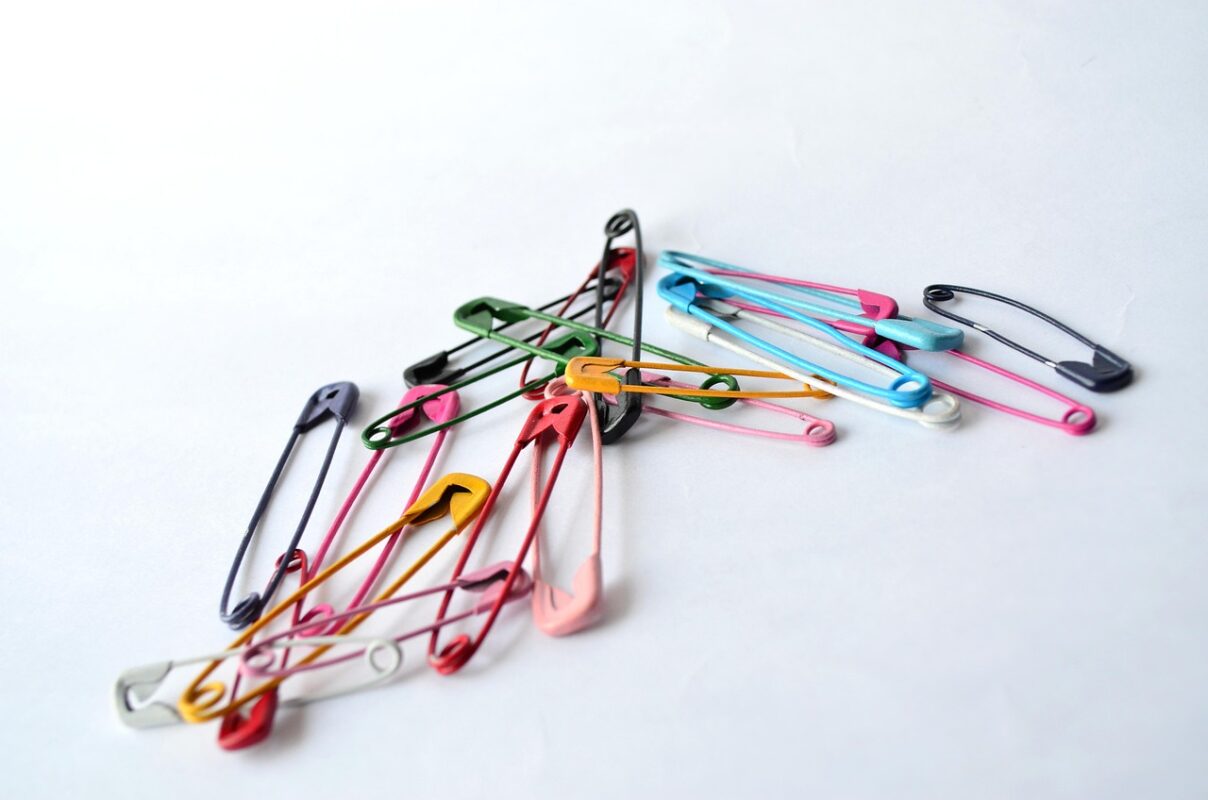
Pins are sold by the box and treated as a commodity, and they are not one. Four properties vary, and using the wrong pin either damages the fabric or bends the pin.
Thickness
Quoted in millimetres or as a gauge number, and it is the property that decides whether a pin leaves a hole.
Fine pins around 0.5mm are for silk, chiffon, fine cotton and anything where a puncture will show. They bend easily and are useless in anything dense.
Standard dressmaking pins, around 0.6mm, cover most garment fabrics.
Heavy pins from 0.7mm upwards are for upholstery, denim, canvas and multiple layers. They will leave a visible hole in fine cloth.
The rule: use the finest pin that will go through without bending. A bent pin is a pin that was too fine for the job.
Length
Ranges from about an inch to over two.
Short pins are precise and get in the way less at the machine. Long pins go through thick layers and are easier to find and grip — which matters in upholstery, where a pin has to pass through fabric, wadding and a webbing layer and still be pullable.
For upholstery, longer is generally better. For fine garment sewing, shorter.
Point shape
Two that matter.
Sharp points are the default and pierce woven fabric cleanly.
Ball point pins have a rounded tip that pushes between the loops of a knit instead of piercing a yarn. Using a sharp pin on jersey can cut a yarn and start a run — this is the one substitution that actually damages the cloth rather than just being inconvenient.
If you sew knits at all, a box of ball-point pins is worth having.
Heads
Glass heads are the practical default. They are visible, easy to grip, and — the important part — they survive an iron. This is the single most useful property of a pin head.
Plastic heads melt. A plastic-headed pin under an iron welds itself to the fabric and to the sole plate. They are cheaper and fine for anything that will not be pressed.
Flat or flower heads lie flush, so a ruler or rotary cutter can pass over them. Quilters use these for exactly that reason.
Steel heads — a plain pin with no head — are the traditional dressmaker’s pin. They disappear into fabric, which is either neat or a nuisance.
Material
Nickel-plated steel is the standard: cheap, strong and it will rust if stored damp.
Stainless steel does not rust and is worth the extra for anything stored in a basement or a garage workshop.
Brass pins do not rust and are softer, so they bend more easily. They are used where a rust mark would be catastrophic.
Anyone with a nickel sensitivity should buy stainless or brass, since pins are handled constantly.
Upholstery specifically
Upholstery uses several fastening tools, and only one of them is a straight pin.
Straight pins hold fabric to fabric during fitting. Skewers and T-pins hold fabric temporarily to a frame or a foam block — a T-pin has a crossbar head that will not pull through and can be gripped hard. Neither replaces the other.
For pinning a slipcover on a chair, long heavy straight pins into the fabric and T-pins into the frame is the usual combination.
When to throw a pin away
Three conditions, none negotiable:
- Bent. A bent pin will not go where you point it and stresses the fabric.
- Blunt or burred. Drag it across your thumbnail; if it catches, it will catch on cloth. The emery strawberry on a tomato cushion fixes light burring.
- Rusted or spotted. Rust transfers to fabric permanently. There is no rescuing this one.
Discard in a sharps container or a sealed tin, not loose in a bin.
Storage
Dry, first and last. Damp is what rusts pins, and a cushion in a damp room rusts the pins inside it.
Keep types separate. A single box with fine silk pins, standard pins and heavy upholstery pins mixed together means selecting a pin by eye every time, and eventually using the wrong one.
A wool-filled cushion leaves a light lanolin film on pins, which slows rust. It is a small effect and it is real.
Where to look
Cushions that arrive with a graded set of pins — usually with a seam ripper, scissors and a tape measure — are on the pin cushions with pin sets page. Cushions on their own are under tomato pin cushions, wooden Japanese pincushions and wrist and novelty pincushions, and if you drop pins, the magnetic pin holders page is the answer.
Pinning direction at the machine
How pins sit in the fabric decides whether they help or cause damage at the needle.
Place pins perpendicular to the seam line, heads towards the raw edge, so they can be pulled out with the right hand as the work feeds. Pins parallel to the seam have to be removed in advance and let the layers shift.
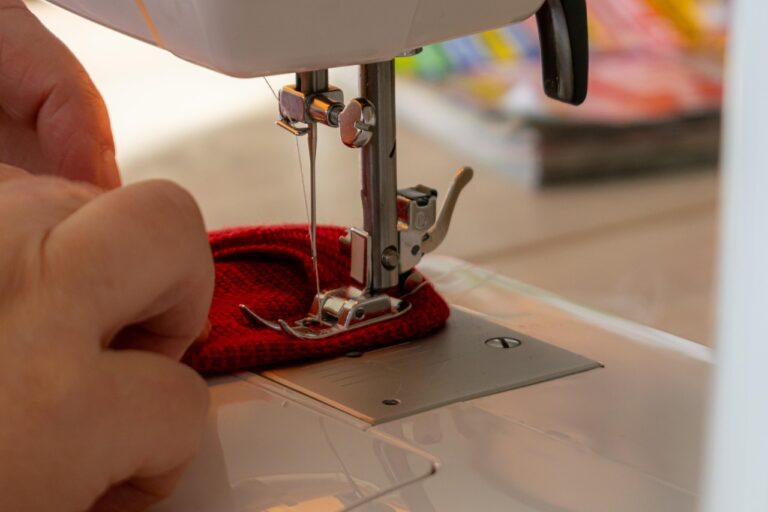
Do not sew over pins. Machines do it and every so often the needle strikes one, which at best breaks the needle and at worst damages the timing or throws a fragment upwards. The saving is a second; the risk is not worth it.
Where pins would mark — leather, coated fabric, velvet — use clips instead. A hole in leather is permanent.